
Scriptures: Overview Luke’s Gospel
Summary of Luke’s Narrative
Gospel of Luke Summary – Part 1
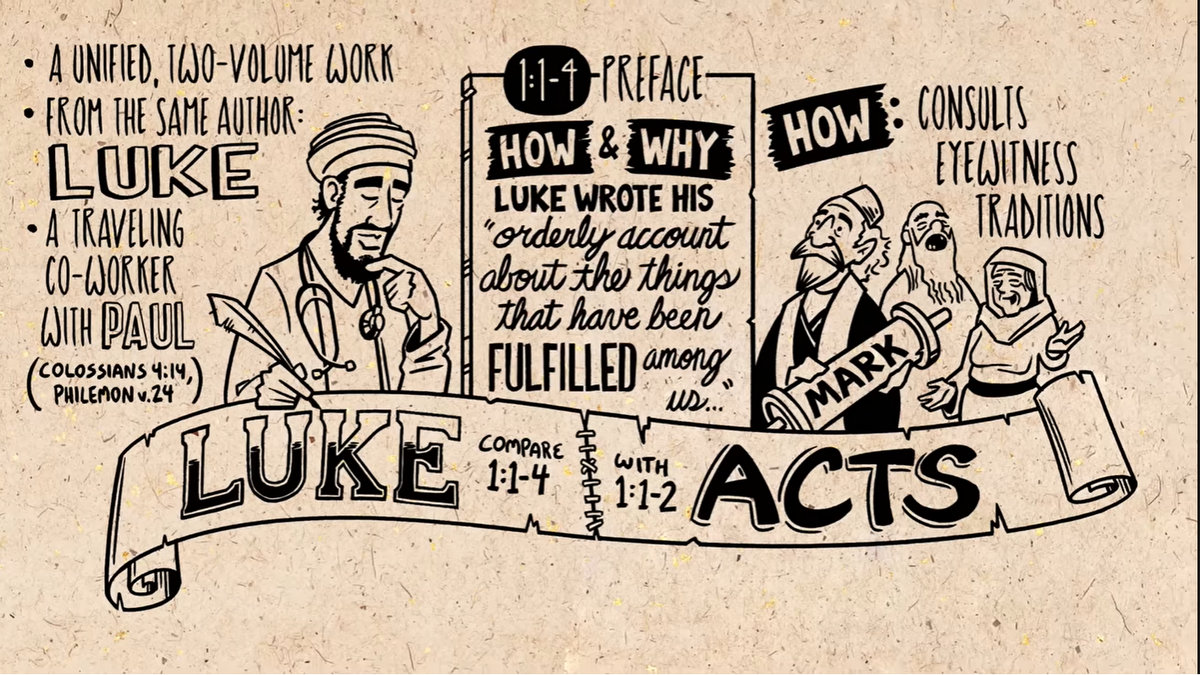
The Gospel of Luke is the one of the earliest accounts of Jesus’ life and constitutes Part 1 of a unified two-volume work, Luke–Acts. The author is identified as Luke, the travelling companion and co-worker of Paul the Apostle, who was also a doctor. Luke wrote an “orderly account” based on eyewitness traditions to demonstrate how the story of Jesus is the fulfillment of God’s covenant story with Israel and the whole world.
The book’s design begins with a long introduction, followed by Jesus’ mission in Galilee (Chapters 3–9), His long journey to Jerusalem, and finally, the climax of His death and resurrection.
The introduction features the parallel birth stories of John the Baptist and Jesus. Their parents sing poems of celebration, which, filled with echoes of the Old Testament, preview their future roles: John is the prophetic messenger who prepares Israel, and Jesus is the Messianic King who brings God’s reign and blessings to the nations. At the temple, the prophet Simeon recognizes Jesus, singing that this child is God’s salvation for Israel and will become a “light to the nations”.
Jesus is identified as the Beloved Son of God, and His genealogy is traced back to David, Abraham, and ultimately to Adam, asserting that He is the Messianic King bringing blessings not just to Israel but “for all humanity”.
Luke uniquely emphasizes the social implications of Jesus’ mission. Jesus launches His public ministry in Nazareth by reading from Isaiah, proclaiming the Spirit is upon Him “to preach good news to the poor and freedom for prisoners”. The term “freedom” (Greek: aphesis) refers to “Release,” symbolizing the ancient Jewish practice of the Year of Jubilee (Leviticus 25), involving the release of slaves, cancellation of debts, and return of lands. The “poor” (ani) includes not only the financially disadvantaged but also people of low social status—such as women, children, the elderly, people with disabilities, social outsiders, and those outside acceptable religious circles.
Luke shows Jesus’ good news in action: healing the sick, forgiving a prostitute, and welcoming social outsiders like the tax collector Levite. Jesus establishes a New Israel by appointing the twelve disciples. He teaches the manifesto of an upside-down Kingdom (the Sermon on the Plain), which calls for a reversal of societal values, radical generosity, serving the poor, peacemaking, forgiveness, and rejecting religious hypocrisy.
This radical vision generates resistance from religious leaders who accuse Jesus of blasphemy and mixing with sinners. Jesus then reveals He is the Messianic King who will assert His reign by dying in Jerusalem as the suffering servant king of Isaiah 53. During the Transfiguration, Moses and Elijah discuss Jesus’ “Exodus” that He is about to fulfill in Jerusalem. This portrays Jesus as a new Moses who will lead His newly formed Israel into freedom from sin, evil, and all forms of tyranny—personal, spiritual, and social.
Gospel of Luke Summary – Part 2
The second half of Luke focuses on Jesus leading His newly formed Israel on a long journey to Jerusalem. This central section consists mainly of Jesus’ teachings and parables given on the road, portraying following Jesus as a journey—something learned as one goes along life’s path.
Disciples are invited to participate in Jesus’ Kingdom mission. Jesus teaches extensively about prayer, trusting God’s provision, and especially money, possessions, and generosity—encouraging a minimalist mentality.
As Jesus travels, He expands the circle of His community, forming His new Israel by encountering and transforming social outsiders, including the sick, the blind, Samaritans (ancient enemies), and Zacchaeus, a chief tax collector for the Romans. These newly integrated people join His Kingdom community, which Jesus describes as a great banquet party. Jesus is here to “seek and save the lost,” celebrating when people discover God’s mercy.
In contrast, when Jesus dines with Israel’s leaders, the banquets become heated debates where Jesus confronts their pride and hypocrisy. This contrast is captured in the Parable of the Prodigal Son, which explains Jesus’ Kingdom mission: a father joyously welcomes his repentant, squandering son (representing the lost), while the older brother resents the father’s generosity. The parable highlights that humility and repentance are the only entry requirements for God’s family, underscoring the tragedy of the leaders who reject Jesus’ upside-down community.
As Jesus nears Jerusalem for Passover, He weeps, knowing the city’s rejection of His Kingdom of peace will lead to rebellion against Rome and the city’s eventual downfall. Jesus symbolically enacts this destruction by storming the temple, driving out sellers, and declaring the place of worship a “den of rebels” that will be destroyed.
During the Passover meal (a symbol of Israel’s liberation), Jesus transforms the bread and wine into new symbols of the new Exodus: His broken body and shed blood will bring liberation for His renewed Israel.
Jesus is arrested, tried, and found innocent three times by Roman Governor Pilate and also by Herod, yet the Jewish leaders compel Pilate to have Him crucified. Even in His painful death, Jesus embodies God’s love and mercy, offering forgiveness to the soldiers and offering hope to the humiliated criminal crucified beside Him: “Today you will be with me in paradise”.
Jesus’ body is placed in a tomb, which His disciples find empty on the first day of the week, with two angelic figures announcing He has risen.
In one of Luke’s most beautiful stories, two disciples leave Jerusalem for Emmaus, heartbroken, and the resurrected Jesus walks beside them unrecognized. Only when Jesus breaks bread with them (as He did at the Passover meal) do they recognize Him. Luke illustrates that the real Jesus is only “seen and known” when disciples submit to the upside-down Kingdom epitomized in His broken body on the cross, offered in self-giving love.
In the concluding scene, Jesus appears to His disciples and explains, using the Old Testament Scriptures, that the Messiah had to suffer and die for their sins and conquer evil through resurrection. Jesus directs His disciples to wait in Jerusalem for the coming of the Spirit to empower them to announce God’s forgiveness to the nations. This sets the stage for Luke’s second volume, the Book of Acts.
The Gospel of Luke Summary – A Visual Introduction
This video provides a visual overview and study guide to the Gospel of Luke, situating it in the context of both the Hebrew scriptures (Tanakh) and the Christian scriptures. Luke is the third book in the New Testament and is Part One of a two-part story, followed by the Book of Acts.
Context: Jesus lived in the region of Judea, under the dominant force of the Roman Empire, in the early 30s CE. This context is marked by the eventual destruction of Jerusalem and the temple by Rome in the year 70 CE.
Authorship and Audience: While the exact author is debated, the writer (traditionally called Luke) was not one of the original disciples or an eyewitness of Jesus’ life. He investigated and interviewed eyewitnesses to write an “orderly account”. The gospel is addressed to “most excellent Theophilus,” a Greek name meaning “lover of God.” This recipient may be a specific person or a general audience of disciples who have been instructed in the ways of Jesus, for whom Luke is providing historical and theological backing. Internal analysis of the Book of Acts suggests the author was a traveling companion of the Apostle Paul.
Portrait of Jesus: Luke presents Jesus as a man born through the power of the Holy Spirit, who was led and empowered by the Spirit throughout His life to proclaim Liberation for the oppressed. It is noted as a beautiful gospel that elevates the role of women, the poor, and the outsider within a patriarchal society.
Structure: The Gospel of Luke is divided into four main parts:
- Preparations (Chapter 1–4:13).
- Jesus’ Ministry in Galilee (Chapter 4:14–9:50).
- The Travel Narrative (Chapter 9:51–19:27): This is a section unique to Luke where Jesus sets his face toward Jerusalem, travelling south and preaching primarily in parables. This is referred to as the good news “on the way”.
- Jesus in Jerusalem (Chapter 19–24): Focuses on the Passion Week, arrest, crucifixion, and unique post-resurrection stories.
Unique Content in Luke: Several well-known stories are found only in this Gospel:
- The classic Nativity Story (Gabriel to Mary, Mary’s Magnificat, the host of heaven appearing to the shepherds).
- The Parable of the Good Samaritan (found in the Travel Narrative).
- The Parables of the Lost Sheep, Lost Coin, and Prodigal Son (illustrating God’s gracious welcome).
- The story of Jesus meeting with Zacchaeus.
- The post-resurrection story of the travelers on the road to Emmaus, who recognize Jesus when He breaks bread.