
Scriptures: Overview of Matthew’s Gospel
Summary of Matthew’s Narrative
The Gospel of Matthew, Part One: Jesus as the Fulfillment of the Old Testament Story
This video offers an in-depth exploration of the first half of the Gospel of Matthew, presenting it not just as an account of Jesus’s life, death, and resurrection, but as a carefully structured work designed to demonstrate how Jesus is the culmination and fulfilment of the entire biblical narrative.
Authorship and Design
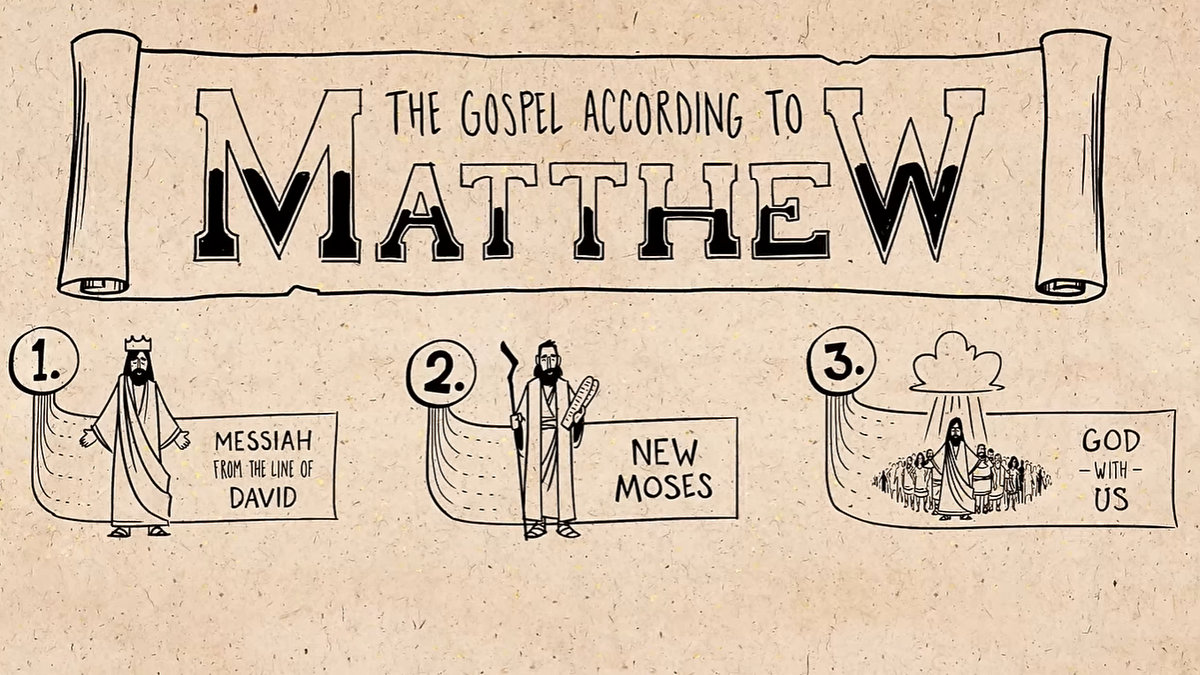
The Gospel is thought to have been written by Matthew, the tax collector who was one of the twelve apostles. He collected and arranged the orally transmitted eyewitness accounts and teachings of Jesus to create a structured narrative. Matthew highlights three key themes:
- Jesus is the Messiah descended from the line of David.
- Jesus is a new, authoritative teacher in the tradition of Moses.
- Jesus is “God with us,” or “Immanuel” in Hebrew.
The book is framed by an introduction and conclusion, surrounding five distinct central sections. This five-part structure, with each section concluding in a major block of Jesus’s teaching, intentionally parallels the five books of Moses (the Torah), presenting Jesus as the new authoritative covenant teacher.
The Introduction: Laying the Foundation (Chapters 1–3)
The opening chapters firmly attach Jesus’s story to the Old Testament. The genealogy establishes him as the son of David (the messianic line) and the son of Abraham (who will bring God’s blessing to all nations). The famous birth narrative shows events fulfilling prophetic promises—that the nations would honour the Messiah and that he would be born in Bethlehem. Furthermore, his conception by the Holy Spirit and his name, Immanuel, demonstrate that Jesus is “God with us,” not just a mere human.
Matthew also draws parallels between Jesus and Moses:
- Like Moses, Jesus came out of Egypt.
- He passed through the waters of Baptism.
- He spent 40 days in the wilderness.
- He went up onto a mountain to deliver his new, divine teaching.
This parallel claims Jesus is the greater-than-Moses figure destined to deliver Israel from slavery, offer new divine teaching, and establish a new covenant.
The Five Teaching Sections (Chapters 4–13)
The central sections focus on Jesus’s ministry and the response it generated:
- The First Section (Chapters 4–7): The Kingdom Arrives. Jesus announces the arrival of God’s Kingdom, which is God’s rescue operation taking place through King Jesus. This kingdom confronts spiritual evil, disease, and death to restore God’s rule. Jesus delivers his first major teaching, the Sermon on the Mount. This teaching describes an “upside-down kingdom” where the poor and “nobodies” are invited, and where Jesus fulfills the Torah, transforming hearts so people can truly love God and neighbor, including their enemy.
- The Second Section (Chapters 8–10): Bringing the Kingdom to Reality. Matthew presents nine stories demonstrating Jesus bringing the kingdom’s power into the lives of hurting, broken people through acts of grace and healing. The power of this grace is experienced by those who follow him and become disciples. This section concludes with the second teaching block, where Jesus sends out the twelve disciples to announce the kingdom.
- The Third Section (Chapters 11–13): Diverse Responses. This section shows a mixed response to Jesus’s message. Some accept him as the Messiah, but others, like John the Baptist and even Jesus’s own family, find him unexpected. Crucially, Israel’s religious leaders—the Pharisees and Bible scholars—are entirely negative, rejecting him as a false teacher making blasphemous claims. In the third teaching block (Chapter 13), Jesus responds with the Parables about the Kingdom (e.g., the four types of soil, the mustard seed, the buried treasure). These parables illustrate that while rejection exists, God’s kingdom is of ultimate value and will continue to spread despite all obstacles.
Throughout these chapters, Matthew strategically weaves in Old Testament quotations to explain Jesus’s identity. Furthermore, readers should notice that the people who readily accept Jesus are often the unimportant or irreligious, while the religious and prideful are the ones most offended by him. This sets up the tension that dominates the second half of the Gospel.
The Climax of Matthew: From Servant King to World Ruler
The second half of the Gospel of Matthew details the intense conflict between Jesus and Israel’s religious leaders, ultimately redefining what it meant to be the Messiah and concluding with Jesus’s resurrection and final command.
The Conflict Over the Messiah’s Identity
In chapters 14 through 20, Matthew explores the differing expectations surrounding the Messiah. While Jesus was widely accepted by many—healing the sick and miraculously feeding both Jewish and non-Jewish crowds in a sign reminiscent of Moses in the wilderness—Israel’s religious leaders, the Pharisees, saw him as a false teacher making blasphemous claims. The leaders were anticipating a victorious Messiah, based on prophecies like those in Psalm 2 or Daniel 2, who would militarily defeat the pagan oppressors and deliver Israel.
As opposition grew, the leaders began hatching a plan to kill Jesus. In response, Jesus withdrew to teach his closest disciples the unexpected truth of his role. Although Peter correctly proclaimed Jesus as “the Messiah, the Son of the living God,” he mistakenly believed Jesus would reign through military power. Jesus challenged this view, instead teaching themes drawn from the prophet Isaiah, predicting that the Messianic King would suffer and die for the sins of his own people.
The Upside-Down Kingdom
Jesus positioned himself as a Servant Messianic King who reigns by becoming a servant and laying down his life for Israel and the nations. Because the disciples failed to grasp this concept, Jesus delivered a series of teachings detailing the “upside down nature” of his kingdom.
In the community of the servant king, all traditional value systems are reversed:
- You gain honor by serving others.
- You forgive and do good to your enemies instead of seeking revenge.
- You gain true wealth by giving away your possessions to the poor.
To follow the Servant Messiah, one must become a servant.
The Clash in Jerusalem
The culmination of the story involves the two kingdoms—Jesus’s and that of Israel’s leaders—clashing. Jesus entered Jerusalem for Passover, riding on a donkey, and was hailed by the crowds as the Messiah. He immediately marched into the temple courtyard, causing a massive disruption that halted the daily sacrifices. By asserting his royal authority over the temple, which he viewed as compromised by the hypocrisy of Israel’s leaders, Jesus directly challenged their power. When the leaders failed to trap and shame him in public debate, they became determined to have him killed.
Before his execution, Jesus delivered his final teaching, passionately critiquing the Pharisees and weeping over Jerusalem’s rejection of God and His Kingdom. He predicted that his leaders’ rejection of the “Peaceful Kingdom” would lead them down the road of revolt against Rome, resulting in the destruction of Jerusalem and its temple. Yet, Jesus assured his disciples that this was not the end.
Sacrifice, Resurrection, and Commission
The narrative reaches its climax with the Passover meal, where Jesus used the bread and wine as new symbols, signifying that his coming death would be a sacrifice to redeem his people from slavery to sin and evil.
After the meal, Jesus was arrested, rejected by the Council of Jewish leaders (the Sanhedrin), and charged with blasphemy. Although the Roman governor, Pilate, believed Jesus was innocent, he succumbed to the pressure of the Jewish leaders and sentenced him to death by crucifixion.
Matthew ensures readers understand that Jesus’s death was not a failure; rather, it was the surprising fulfillment of all the old, prophetic promises. He was the Servant Messiah described by Isaiah, who, rejected by his people, was judged on their behalf, bearing the consequences of their sin.
The book ends with a surprising twist: the discovery that Jesus’s tomb is empty on Sunday morning, followed by sightings of him alive from the dead. The risen Jesus delivered his final instruction, known as the Great Commission. Declaring that he is now the true king of the world, Jesus sent his disciples out to all nations to spread the good news, baptize, and follow his teachings. Echoing his name, Emmanuel (“God with us”), Jesus’s last words were a promise of his abiding presence “until the day he finally returns”.
Understanding the Gospel: An Introduction to Matthew
In this video guide, Steve Thomason provides a detailed overview to put the Gospel of Matthew into context, covering its place in the Bible, its geography and historical setting, and its unique organizational structure.
Matthew on the Bookshelf
The Christian scripture can be thought of as a bookshelf composed of five distinct collections of documents. The Gospel according to Matthew is the very first book on the first shelf, which holds the Gospels—books that paint a theological portrait of Jesus from four different perspectives,.
The other sections of the Christian scripture include the Acts of the Apostles, which tells the story of the first generation of Jesus’s followers trying to interpret Jesus’s message within the Greco-Roman world. Following this are the letters written by leaders: the Apostle Paul has his own shelf due to the volume of his correspondence, followed by the general letters written by other leaders. The final shelf holds the book known as the revelation of Jesus Christ.
The Geography and Historical Backdrop
The entire story told within scripture takes place within a limited, highlighted section of the world, though people in those days were aware of groups like the “barbarians” up north, tribes in northern Africa, and people in India and China.
For the Gospel of Matthew, two major cultures are critical to understanding the context:
- The Roman Empire: They were “large and in charge” during the time of Jesus, with their territory stretching to the British Isles, Spain, the northern coast of Africa, and Germania.
- The Vestiges of the Persian Empire: This is important because the Persians conquered the Babylonians, who were responsible for conquering Jerusalem and leading the people into 70 years of Exile,. The story of the Magi coming from the East at the very beginning of Matthew highlights this eastern connection.
The Jesus story itself takes place in a tiny section of land called the Holy Land, modern-day Israel. Important geographical features include the Mediterranean Sea (or the Great Sea). Up north is the freshwater Sea of Galilee, which is connected by the Jordan River to the Dead Sea—a body of water full of minerals where water flows in but does not flow out.
Most of the story in Matthew takes place in the northern region called Galilee. Jesus grew up in Nazareth and based his ministry headquarters in the fishing village of Capernaum on the shore of the Sea of Galilee. This northern ministry covers about three years and makes up the first two-thirds of the book,. The story intensifies when Jesus goes south to the city of Jerusalem (near where he was born in Bethlehem). The final third of the story, however, happens in just one week in Jerusalem.
Organizing Matthew: The Five Discourses
Most scholars organize Matthew by observing five particular types of literature known as the discourses. A discourse is simply a section where the author collects Jesus’s teachings on a specific subject. Four of these occur during the ministry in Galilee, while the fifth happens in Jerusalem.
The five discourses are:
- The Ethical Discourse (Chapters 5–7): More commonly known as The Sermon on the Mount, this contains the quintessential teaching of Jesus focusing on the ethics of the kingdom of heaven.
- The Mission Discourse (Chapters 9–10): Here, Jesus sends his disciples out to replicate his work, which included healing people, curing the sick, casting out demons, feeding the poor, and proclaiming the message of the Kingdom of Heaven.
- The Parables Discourse (Chapter 13): This section focuses on Jesus teaching in a unique way through parables—quick, simple stories that are often hard to fully understand.
- The Community Discourse (Chapter 18): Jesus lays out his vision for the community of the Kingdom of Heaven, emphasizing that it is built on forgiveness and inclusion, rather than wealth and power,.
- The Final Discourse (in Jerusalem): Occurring when Jesus arrives in Jerusalem, this discourse focuses on the coming of the end of the age, specifically predicting the destruction of Jerusalem. This prediction was historically fulfilled in the year 70 when the Jewish people were crushed by the Roman Empire after four years of war, resulting in the complete destruction of the Temple.
Go Deeper
An Upside-Down Kingdom: How Matthew Redefines Power and Grace
For many, the Gospel of Matthew is simply the first book of the New Testament—the opening chapter of Jesus’s story. It’s a familiar starting point, but its familiarity can often hide its depth.
Matthew is not just a straightforward historical account; it is a meticulously crafted literary and theological masterpiece. The author uses intentional structure, narrative pacing, and thematic twists to reveal deeper truths about who Jesus was and what his message truly meant.
This post will uncover four of the most surprising and impactful insights hidden within the book’s design, revealing a story that is more intentional, radical, and profound than commonly assumed.
- Structured as a “New Torah”
- Lopsided narrative pacing
- Servant King, not Conqueror
- Upside-Down Kingdom
Overall Theme: Matthew’s Gospel is a carefully crafted literary masterpiece with intentional structure and design, not just a simple historical account. The book frames Jesus’s entire story around the promise “God with us” (Immanuel).