
An Upside-Down Kingdom: How Matthew Redefines Power and Grace
For many, the Gospel of Matthew is simply the first book of the New Testament—the opening chapter of Jesus’s story. It’s a familiar starting point, but its familiarity can often hide its depth.
Matthew is not just a straightforward historical account; it is a meticulously crafted literary and theological masterpiece. The author uses intentional structure, narrative pacing, and thematic twists to reveal deeper truths about who Jesus was and what his message truly meant.
This post will uncover four of the most surprising and impactful insights hidden within the book’s design, revealing a story that is more intentional, radical, and profound than commonly assumed.
1. It’s Deliberately Structured to Be a ‘New Torah’
Scholars have long observed that Matthew is intentionally designed with a five-part structure, framed by an introduction and a conclusion. This structural decision, or narrative architecture, is a profound theological statement.
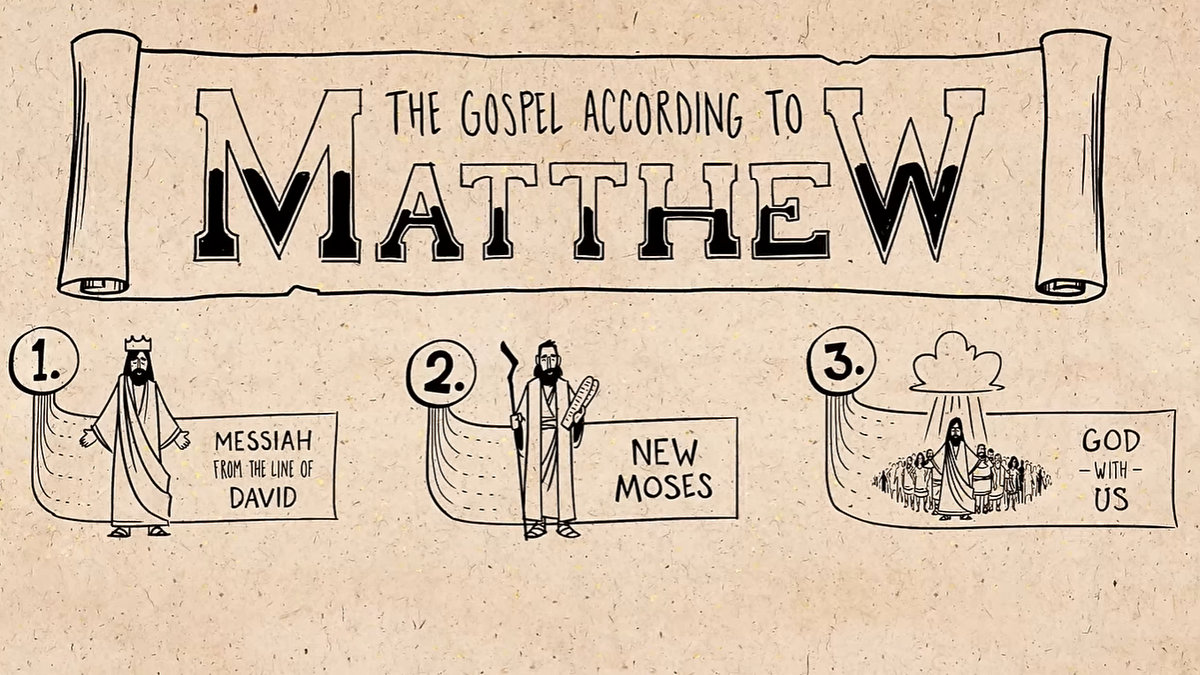
This five-part structure is a direct parallel to the first five books of the Old Testament, known as the Torah or the five books of Moses. To make the connection undeniable, Matthew masterfully weaves parallels between the two figures. Like Moses, Jesus came up out of Egypt, he passed through the waters of Baptism, he entered into the wilderness for 40 days, and then he goes up onto a mountain to deliver his new teaching. By organizing his account this way, Matthew presents Jesus as a “new authoritative teacher like Moses” who has come to “fulfill the story line of the Torah.”
Each of the five sections concludes with a long block of Jesus’s teaching, which scholars call the “five discourses.” These discourses collect Jesus’s teachings on specific topics:
- The ethical discourse (The Sermon on the Mount)
- The mission discourse
- The parables discourse
- The community discourse
- The discourse about the end of the age
2. Two-Thirds of the Book Covers Three Years; The Final Third Covers Just One Week
A striking feature of Matthew’s narrative is its shockingly lopsided pacing. The first two-thirds of the story, which detail Jesus’s ministry, take place over approximately three years in the northern region of Galilee. In stark contrast, the last third of the book focuses intensely on a single week: Jesus’s final days in the city of Jerusalem.
This is a deliberate, cinematic choice by the author. Matthew effectively uses a long, steady shot for three years of ministry and then cuts to a breathless, moment-by-moment close-up for the final week. This radical shift in focus forces the reader to understand that everything—every teaching, every miracle—was leading to this single, climactic confrontation in Jerusalem. It frames Jesus’s journey and the events that unfold there as the ultimate climax of his entire life, giving every moment of that final week profound weight and significance.
3. The Hero Was a Servant King, Not a Conquering One
The common expectation for the Messiah at the time was clear: the people and their religious leaders were looking for a “victorious Messiah who is going to deliver Israel and defeat the pagan oppressors.” They anticipated a powerful king who would reign through military might.
In a masterful twist on his audience’s expectations, Jesus directly challenges this at every turn. This is a deliberate subversion of the conquering hero trope. He positions himself as a completely different kind of king—one who would reign not by conquering others, but by becoming a servant.
This radical redefinition of messianic power is central to Matthew’s account.
“Jesus was positioning himself as a Messianic king who reigns by becoming a servant and who would lay down his life for Israel and the nations.”
Ultimately, Jesus’s death was not a failure of his mission but its “surprising fulfillment.” It fulfilled the ancient prophecies of a servant Messiah who would suffer and die for the sins of his people, revealing a kingdom built on sacrifice, not dominance.
4. The Kingdom is an ‘Upside-Down’ World for Outsiders
Jesus’s central message was about the arrival of God’s kingdom, but this kingdom operated by a set of rules that were completely inverted from the world’s values. Matthew presents it as an “upside-down kingdom” where you gain honor by serving others, you find true wealth by giving your own away, and you respond to your enemies with forgiveness, not revenge.
Because these values are so inverted, the kingdom proves uniquely appealing to a specific audience. The people who accept Jesus and his message are “most often people who are unimportant… or they’re irreligious.” These are the people with nothing to lose and everything to gain in a world not built on their success. In contrast, the world’s inverted values mean that it is the “religious and the prideful who are offended by him,” as his teachings threaten the very power structures they benefit from. This vision of community was not built on power and wealth but on “forgiveness and inclusion,” inviting in the very people society had overlooked.
Conclusion: A Story Designed to Be Rediscovered
From its Torah-like architecture and lopsided pacing to its radical redefinition of a servant king and his upside-down kingdom, Matthew’s Gospel reveals itself as a masterwork of intentional design. It is far more than a simple biography; it is a deeply intentional work of literary art that consistently defies expectations.
Knowing that every detail in Matthew—from its structure to its final words—is intentional, what other hidden layers might be waiting for us to discover?
The book ends with the promise of the risen Jesus to his followers: “I will be with you.” This final statement echoes his name from the very first chapter—Immanuel, which means “God with us”—framing the entire story as a promise of divine presence that continues to this day.
I love this post