
Scriptures: Overview of John’s Gospel
Summary of John’s Narrative (2 Parts)
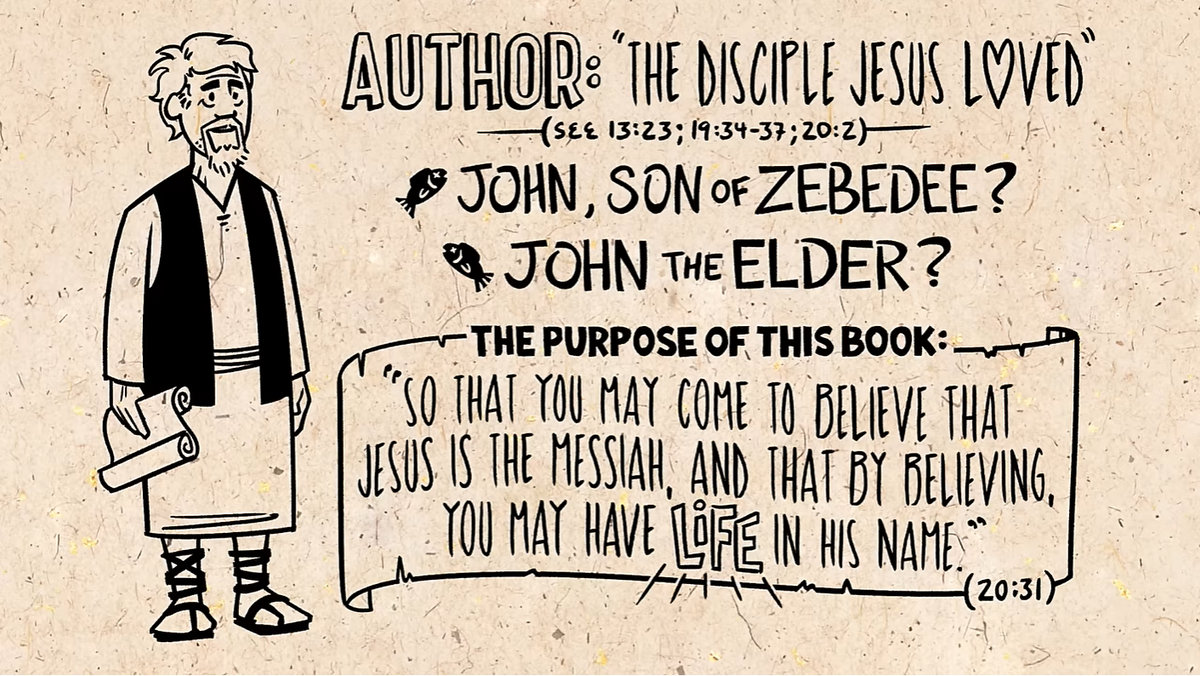
This video provides an overview of The Gospel According to John, one of the earliest accounts of Jesus’ life, embodying the eyewitness testimony of “the disciple whom Jesus loved”. The Gospel’s purpose, as stated near the end, is written so that readers “may come to believe that Jesus is the Messiah and that by believing you may have life in his name”.
This video focuses specifically on the first half of the book, which opens with a two-part introduction followed by a large block of stories detailing Jesus’ miraculous signs and the controversy they generate,.
The Introduction
The book begins with a poem starting, “In the beginning was the Word,” which alludes to Genesis 1. The poem claims that God’s Word was distinct from God yet also divine (“the Word was God”), and this Divine Word became human in Jesus. Jesus is described as God’s Tabernacle in our midst, the glorious divine presence, revealing that the one true God of Israel consists of the Father and the Son.
Following the poem is a short story in which John the Baptist introduces others to Jesus. As people encounter Jesus, they give him seven titles, claiming this fully human Jesus from Nazareth is the Messianic King, the teacher of Israel, and the Son of God who will die for the sins of the world,.
Signs, Claims, and Controversy
Chapters 2 through 12 present stories that support this major claim. They follow a pattern: Jesus performs a sign or makes a claim about himself, which causes misunderstanding or controversy, ultimately forcing people to make a choice about who they believe Jesus is,.
In this section, Jesus encounters and supersedes four classic Jewish institutions:
- Wedding Party: Jesus turns large jugs of water into the best wine, a miracle John calls his first sign. This reveals the generosity of Jesus’ Kingdom, which Isaiah said would be like a huge party with good wine.
- Jerusalem Temple: Jesus asserts his authority by driving out money exchangers. When temple leaders confront him, he says, “destroy this temple and I will raise it again in three days,” claiming his coming sacrificial death is the reality where heaven and earth will truly meet, superseding the temple building,.
- Rabbinic Teaching: In a conversation with Rabbi Nicodemus, Jesus explains that Israel needs more than a new teacher; they need a new life. He states that no one can experience God’s kingdom “without being born again” to escape the web of selfishness and sin,.
- Sacred Well: Jesus speaks to a Samaritan woman and uses water as a metaphor, offering “living water” that provides a new quality of life, “infused with God’s eternal love,” which begins now and lasts into the future,.
John also presents stories that take place during four Jewish sacred days or feasts, where Jesus utilizes the feasts’ imagery to make claims about himself:
- On the Sabbath, Jesus heals a man and defends his action by claiming his Father works on the Sabbath, and so does he, making himself equal with God, leading to calls for his death,.
- During Passover, after miraculously providing food for thousands, Jesus claims that he is the true bread, and those who “eat him” will discover eternal life.
- During the Feast of Tabernacles, which recalled God’s guidance and provision in the desert, Jesus shouted in the temple courts, “if anyone is thirsty let them come to me and drink,” and later claimed, “I am the light of the world,” asserting that he is the illuminating and life-saving presence of God.
- During Hanukkah (the Feast of Rededication), Jesus goes into the temple area and says he is the one God has set apart as the Holy One and the true temple, stating plainly, “I and the Father are one“. This declaration angers the Jerusalem leaders and sets in motion a plan to kill him,.
The Climax
All these conflicts culminate in Jesus’ final miraculous sign in the first half: the raising of Lazarus. Although Lazarus’ family lived near Jerusalem, a known “death trap” for Jesus, he chose to go there out of love to call his friend to life, knowing this act would cost him his own. News of this sign spread quickly, and the Jerusalem leaders began conspiring to murder him,. The first half of the Gospel ends with Jesus riding into Jerusalem, rejected by its leaders, as he lays down his life as an act of love, foreshadowing the cross.
This video provides an overview of the second half of the Gospel According to John, which focuses on Jesus’ final hours, death, resurrection, and the commissioning of his disciples.
The Gospel’s primary claim, demonstrated throughout the book, is that Jesus is the Messiah, the Son of God, the human embodiment of God’s Word and glorious presence who came to reveal God’s true nature. The first half of the book demonstrated this claim through Jesus’ miraculous signs and claims, which generated controversy and culminated in Jesus sealing his fate by raising Lazarus near Jerusalem.
The second half of the book begins once the plot to murder Jesus is in motion.
Jesus’ Final Night with His Disciples
The initial part of the second half focuses on Jesus’ last night and final words to his disciples, preparing them for his coming death.
- The Act of Service: Jesus performs a shocking act at dinner, taking on the role of a common servant by washing their feet—a role a superior rabbi would never perform for his disciples. Jesus declares this act symbolizes his entire life’s purpose: revealing God’s true nature as a being of self-giving love, and symbolizing his impending death for the sins of the world.
- The Great Command: This act leads to Jesus’ great command that his followers are to love one another as he loved them; acts of loving generosity must be the hallmark of his followers, showing the world who Jesus, and therefore who God, is.
- The Advocate: Jesus gives a long speech and concluding prayer, repeatedly stating that he is “going away”. Although this saddens the disciples, Jesus explains it is for the best because he will send The Spirit, also known as The Advocate. While Jesus as a human could only be in one place, the Spirit will be Jesus’ divine, personal presence everywhere, at any time.
- Abiding in Love: The unique deity of the One God, according to John, consists of the loving, unified relationship between the Father and the Son. Jesus says the Spirit is this loving personal presence that will live in his people, drawing them into the love between the Father and the Son. The disciples are those who “abide or remain in that divine love,” connected like branches to a vine, allowing the personal love of God to permeate, heal, and transform their lives.
- The Mission: The Spirit will also empower Jesus’ followers to carry on his mission. This involves fulfilling the command to love others through radical service, but also bearing witness to the truth. This involves exposing the selfish, sinful ways humans treat each other and declaring that God has saved the world through Jesus out of love, opening a new path to becoming fully human.
- Victory: Jesus predicts that his followers will face opposition and persecution, just as the Jewish leaders rejected him. He tells them not to be afraid because He has already conquered or gained victory over the world.
Trial, Crucifixion, and Resurrection
The final section of the book shows what Jesus’ “victory” looks like.
- The “I Am” Climax: When Jewish leaders send soldiers to arrest Jesus, and they ask which one he is, Jesus declares, “I am” (in Greek, ego eimi), and the soldiers fall backward. This is the ironic climax of the many times John has strategically placed the divine name (the Greek translation of God’s personal covenant name revealed to Moses) into the narrative. Jesus used the phrase in seven instances followed by an astounding claim (e.g., “I am the bread of life,” “I am the light of the world”), and also seven other times simply saying “I am”. Here, Jesus reveals his divine name, power, and victory precisely at the moment he gives up his life.
- The Upside Down Kingdom: Jesus is put on trial for claiming to be the Son of God and the King of Israel. When questioned by the Roman governor Pilate, Jesus clarifies that while his Kingdom is for this world, it is “not from this world”. Its radically different value system and redefinition of power and greatness are derived from God’s character, epitomized by the cross. The cross is where the world’s true King conquers sin and evil by allowing them to conquer him, gaining victory through an act of self-giving love.
- The Seventh Sign: After Jesus is placed in the tomb, Mary and the disciples discover it is open and empty on the first day of the week, and Mary then meets the resurrected Jesus. John highlighted Jesus’ first sign (water into wine) and second sign (healing a sick boy) early in the Gospel. By counting the signs, one realizes that the raising of Lazarus was the sixth sign, and the resurrection of Jesus from the dead is the seventh and greatest sign at the story’s culmination. The resurrection vindicates Jesus’ claim to be the Son of God and the author of all life, whose love has conquered death.
Commission and Epilogue
After the empty tomb, Jesus commissions his disciples by sending the Spirit, as promised, so that his mission from the Father can be carried on through them.
The book concludes with an epilogue exploring the ongoing mission of Jesus’ disciples.
- Discipleship: Jesus appears to several disciples who are fishing unsuccessfully. When they obey his unrecognized voice and cast their net on the other side, they catch a massive amount of fish. John uses this scene to illustrate discipleship: followers are most effective when they focus on simply listening for Jesus’ voice and obeying him when he speaks, which allows them to truly see him at work.
- Witness: Jesus commissions Peter as a unique leader, predicting that Peter will also give up his life one day. The story concludes by focusing on the author of the Gospel—”the disciple whom Jesus loved”—whose role was not to lead but to spend his long life bearing witness to Jesus. The author completed this job by writing this amazing story about Jesus the Messiah, the Son of God, so that others might believe in him.
The Gospel of John is essentially this amazing story about Jesus the Messiah, the Son of God.
This video, titled “Laying Out John in Logos Bible Software YouTube Preview,” features Steve Thomason explaining his process for studying the Gospel of John before creating a “Cartoonist Guide to John”.
The purpose of the video is to show the behind-the-scenes work involved in diving into the Gospel of John. Thomason notes that before drawing any pictures, he studies the text very closely.
Study Methods and Tools
Thomason highlights several tools and techniques he uses in the Logos Bible Software:
- Commentary: He mentions using a favorite commentary on the Gospel of John written by Karoline Lewis.
- Previous Work: Thomason notes that he has worked through John visually once before, four years prior, which is when he began his comic book style. Although he doesn’t have a complete version, he has created many visuals through chapter 18.
- Outlining: He creates a note to lay out different possible ways people have outlined the Gospel of John, including an image from the Bible Project. A typical outline includes an introduction (John 1) and the Book of Signs, which details seven signs and seven “I Am” statements by Jesus that reveal his identity.
Analyzing the Text
Thomason details his methodical approach to analyzing the text:
- Narrative Lectionary Tracking: As he often preaches through the narrative lectionary, he first created a note listing all the preaching texts from the lectionary and color-coded them in green. This exercise exposed the parts of the text that the lectionary skips over. He then went through and identified all these gaps, noting, for example, that many verses were skipped in chapters 5 and 6. Since his “Cartoonist Guide” is aimed partly at narrative lectionary preachers, he finds it important to know what is included and what is not.
- Location and Festival Tracking: In a second pass, Thomason created a note specifically for “location and festival tracking”. He analyzed the text for himself, highlighting specific elements:
- Locations: He highlighted whenever Jesus travels to a new location, such as deciding to go to Galilee.
- Signs: He highlighted Jesus’ signs in purple, noting that the author of John explicitly calls them “the first of his signs”.
- Feasts/Festivals: He highlighted mentions of Jewish feasts and festivals because he noticed that all of Jesus’ movements seem to be related to them.
- “I Am” Statements: He highlighted in blue every instance where Jesus says “I am”.
This video sample is part of a longer, more in-depth video that is available to members of the CB Crew, where they can collaborate on drawing through the Gospel of John.
Go Deeper
More than a Biography: What John’s Gospel Reveals About Jesus
What if the most famous story in history wasn’t just a biography—but a masterclass in literary genius?
The Gospel of John isn’t just about Jesus’ life; it’s a bold, poetic, and deeply intentional masterpiece that challenges readers from the very first line. It opens with a cosmic poem declaring that the divine Word became flesh—setting the stage for a narrative unlike any other.
From seven miraculous signs to shocking “I am” declarations, every detail builds toward a radical truth: Jesus isn’t just a teacher or miracle worker—he’s God in human form.
And the climax? A cross not as defeat, but as divine victory. This isn’t history as you know it. It’s a story that demands to be read, not just believed.